




SHORT BIO
Jonas Hollevoet is a Belgian film director whose work balances tragedy and humor, color and darkness. His films explore the absurd in the everyday and celebrates the fragile chaos of being human. Colorful, tragicomic, and strangely familiar.
FILMOGRAPHY
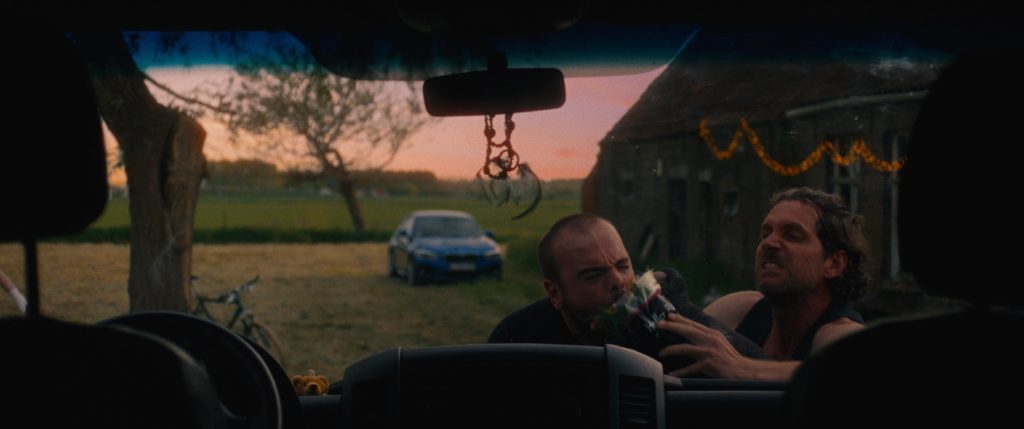
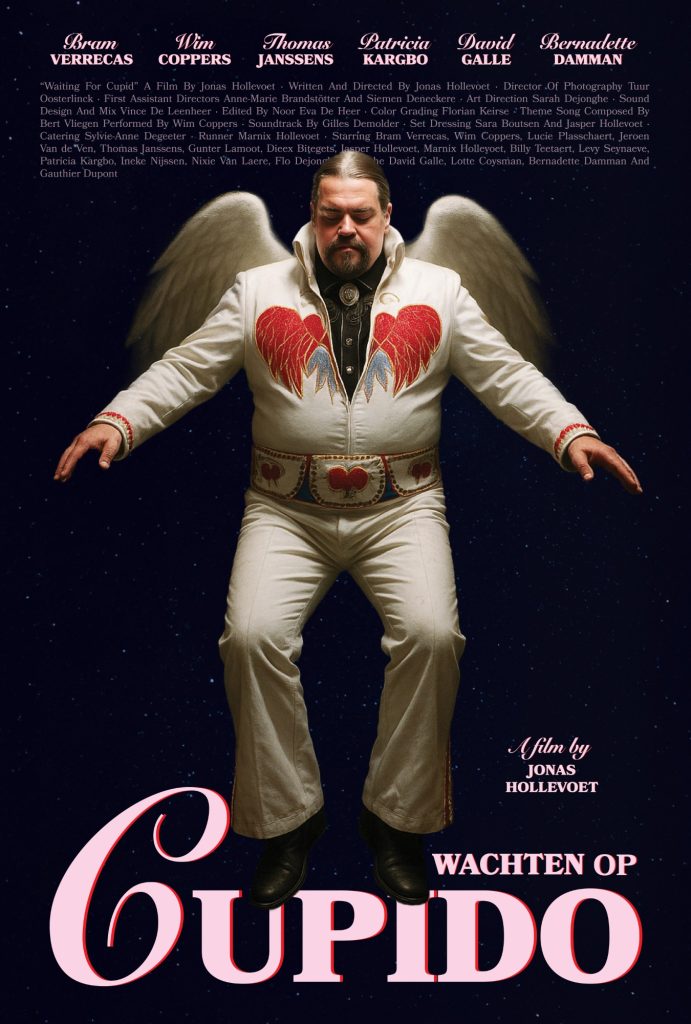
Poor Boy Long Way From Home (2022), Waiting For Cupid (2025)
- What is the first story you ever wrote?
I honestly don’t remember the very first one, but I do remember always writing in little notebooks as a kid. I made comics, strange little stories, drawings with dialogue bubbles. I was constantly inventing worlds without even realizing that’s what I was doing.
One story I vividly remember was about a baby born with a skeleton made of gold. Because of that, the baby weighed hundreds of kilos. I don’t even remember the plot anymore, which is kind of tragic, but the image stuck with me. A fragile newborn with this incredibly heavy, precious interior. It was bizarre, almost grotesque, but also strangely poetic.
Looking back, it makes sense. Even then I was drawn to contrast. Beauty and burden. Value and weight. Something exaggerated, slightly absurd, but rooted in something emotional. I think I’ve been telling stories for as long as I can remember. It was never a decision like, “I want to be a storyteller.” It was just how I processed things.
In many ways, I’m still that child with the notebook. The medium changed, but the impulse didn’t.
- Growing up, what movies or stories inspired your creative passion?
As a kid, films felt like portals. Watching Cars completely transported me. It sounds simple, but I remember truly believing in that world. Talking cars, endless highways, sunsets in the desert. It made me realize that cinema can build its own reality and invite you inside.
Then later I watched Trainspotting, and that was a completely different experience. That film almost shocked me awake. It disturbed me, fascinated me, maybe even traumatized me a little, but in a good way. The energy, the rawness, the lack of politeness. It showed me that cinema could be messy, uncomfortable, and still incredibly poetic.
What stayed with me is that contrast. On one side, pure escapism and wonder. On the other, brutal honesty and chaos. I think my work still lives somewhere between those two energies.
- For an unknown writer, what is the best way to get their screenplay seen?
For me, everything changed when I stopped waiting and started making things. Even small, imperfect short films helped more than sending out scripts ever did. A screenplay is potential. A finished film is proof. Once people can see your voice, your rhythm, your tone, they understand you much faster.
I also believe relationships grow slowly and naturally. Festivals, conversations after screenings, small collaborations. Not networking in a calculated way, but just connecting as someone who genuinely loves cinema.
And the writing itself has to feel urgent. You can sense when a script exists because it had to be written, and when it exists to impress someone. In the beginning especially, it helps to write something that can actually be made. Limitations shape you. Some of my strongest ideas came from constraints.
- What experiences from your life influence your characters?
It’s rarely big dramatic events. It’s small things. Doubt. Embarrassment. Wanting to be seen but also wanting to disappear. That fragile space between confidence and collapse really interests me.
I’m fascinated by moments where someone tries to maintain dignity, but reality slightly humiliates them. Those situations are deeply human and often tragicomic.
Travel has influenced me too. Being on the road, feeling small in landscapes, observing strangers. That sense of transience often slips into my characters. People searching. People drifting. People holding onto something fragile.
I don’t copy real life directly, but I always start from something I’ve truly felt. The insecurity, the absurdity, the beauty of being human.
- Can you explain your character development process?
My character development always starts with observation. I watch people constantly. On the street, in supermarkets, at gas stations, during awkward conversations. I am fascinated by how someone stands, how they hesitate before speaking, how they laugh too loudly or not at all.
Very often I already carry certain characters in my head long before I write them. They are fragments at first. A posture. A voice. A contradiction. I collect these details almost unconsciously. For me, reality is the greatest source of fiction.
I love to take something small and make it slightly larger than life. Not in a caricatured way, but in a poetic way. If someone is stubborn, I push that stubbornness just a little further. If someone is fragile, I let that fragility become almost monumental. By enlarging certain aspects, the character becomes more cinematic, yet still rooted in something real.
I truly believe the human being is one of the most incomprehensible and beautiful creatures. Almost every person is a film in themselves. When you really look at someone, you sense history, desire, shame, dreams, absurdity. It is all there, even in silence.
So my process is less about constructing psychology on paper and more about distilling what I observe. I take reality, filter it through my own sensibility, and then heighten certain elements until they feel both truthful and slightly surreal.
In the end, I want my characters to feel recognizable but also a bit mythic. Like you have seen them before in real life, but never quite like this.
- Do you write bios before you start writing? Yes, always.
Even if a character starts from intuition, I need to know where they come from. Their childhood. Their first heartbreak. Their secret fear. Not everything ends up on screen, but I need to know it.
Sometimes it’s practical details. Sometimes it’s emotional questions. What do they want but would never admit? What illusion do they have about themselves?
Once I know that, writing becomes easier. I’m not inventing reactions anymore. I’m simply asking how this specific person would behave.
- How emotionally involved are you with the characters you create?
It really varies from project to project and from character to character. Some characters feel very close to me from the beginning. Others take more time. But almost always, once I start writing and spending time with them, I develop a bond.
Even with characters I do not agree with on a social or political level, I try to understand them rather than judge them. If I judge them, they become flat. If I try to see the world through their eyes, even briefly, they become human. And that is much more interesting to me.
I think emotional involvement is necessary. Otherwise the character remains an idea. When I work on a film for months, the characters live with me. I think about how they would react in situations that are not even in the script. They start to feel autonomous, almost stubborn. Sometimes they surprise me.
At the same time, I try to keep a certain distance as a director. I care about them deeply, but I cannot protect them too much. They need to fail. They need to be exposed. They need to be uncomfortable. That vulnerability is often where the film becomes honest.
So yes, I get emotionally involved. Not because I agree with every character, but because I believe that even the most contradictory person deserves to be seen in their complexity.
- What are your thoughts on structure?
I love working within a structure. It gives me calm. It gives me orientation. When I know the architecture of a film, even loosely, I feel more free inside it. Structure creates a kind of safety. It allows me to experiment emotionally because I know there is a framework holding everything together.
At the same time, I am very aware that structure should never become a prison. Sometimes the most interesting moments happen when you deliberately break it. When a rhythm is interrupted. When a scene goes on longer than expected. When the narrative suddenly shifts direction. Those ruptures can open a completely new dimension.
For me, structure is like a skeleton. You need it. But the life of the film is in the flesh, the breath, the unpredictability. If everything follows the plan too neatly, it can feel dead. So I build structure carefully, and then I allow myself to damage it a little. To disturb it.
I enjoy that tension between control and chaos. Between precision and intuition. That is often where something surprising emerges.
- Do you outline before you start writing?
For me, the outline is about knowing where I am going. I need to understand the trajectory of the film, the emotional arc, the ending. Even if things change later, I need a direction. Without that, I feel lost.
Honestly, outlining is often the hardest part of the whole process. It is where you confront the core of the film. What is it really about? Why does this scene follow the previous one? What is the progression? These questions are not romantic, they are structural, and they demand clarity.
When I outline, I try to see the film almost as a sequence of movements. Not only plot points, but emotional shifts. Where does the tension rise? Where does it breathe? Where does it break?
Once the outline is solid, writing becomes more intuitive and fluid. I can focus on atmosphere, details, gestures, silences, because the skeleton is already there. The outline gives me confidence. It allows me to take risks inside the scenes because I know the overall direction is clear.
- What is the most important aspect of building a great character?
For me, the most important aspect of building a great character is honesty. You have to truly feel why a character does what they do. Even if their behavior is extreme, extravagant, or very introverted, it has to come from something deeply human.
I am not interested in characters who act just to serve the plot. I want to understand their inner logic. Why do they make this choice. What are they protecting. What are they afraid of. When you feel that emotional truth, the audience will feel it too.
I am also very drawn to vulnerability. I love showing the fragile side of someone, especially when it contrasts with how they present themselves to the world. That tension fascinates me. The gap between reality and how a character sees themselves can be tragic, but also absurd and poetic.
A character might think they are strong, independent, in control, while in reality they are deeply lonely. Or someone who appears ridiculous might carry enormous sensitivity inside. That contrast creates depth.
In the end, as long as the character feels rooted in real humanity, I believe they can be as quiet or as extravagant as you want. Honesty is what makes them alive.

